
Derma PCD Franchise Price List Breakdown

A Derma PCD franchise price list is not just a list of product prices, but it helps you to understand your purchase cost, retailer price, profit margin, and overall business values. However, terms like PTR, PTS, Net Rate, and MRP can be confusing, especially if you are new to this field. Understanding these terms is important when comparing a derma franchise price list in India. A product with MRP does not always give you high profit. Your actual earnings depend on various factors, such as the net purchase rate, selling price, schemes, taxes, product category, and business expenses.
In this blog, we have mentioned a complete derma PCD franchise price list breakdown to help you understand the pricing structure, including PTR, PTS, MRP, net rate, and profit margins. This guide will help you to compare product prices and understand the potential returns before choosing a dermatology PCD franchise business in India.
Why Understanding a Derma PCD Price List Matters
Understanding a price list of a Derma PCD franchise helps you to know your actual purchase cost, selling price, and potential profit. It includes important details, such as MRP, PTR, PTS, net rate, trade margins, and schemes.
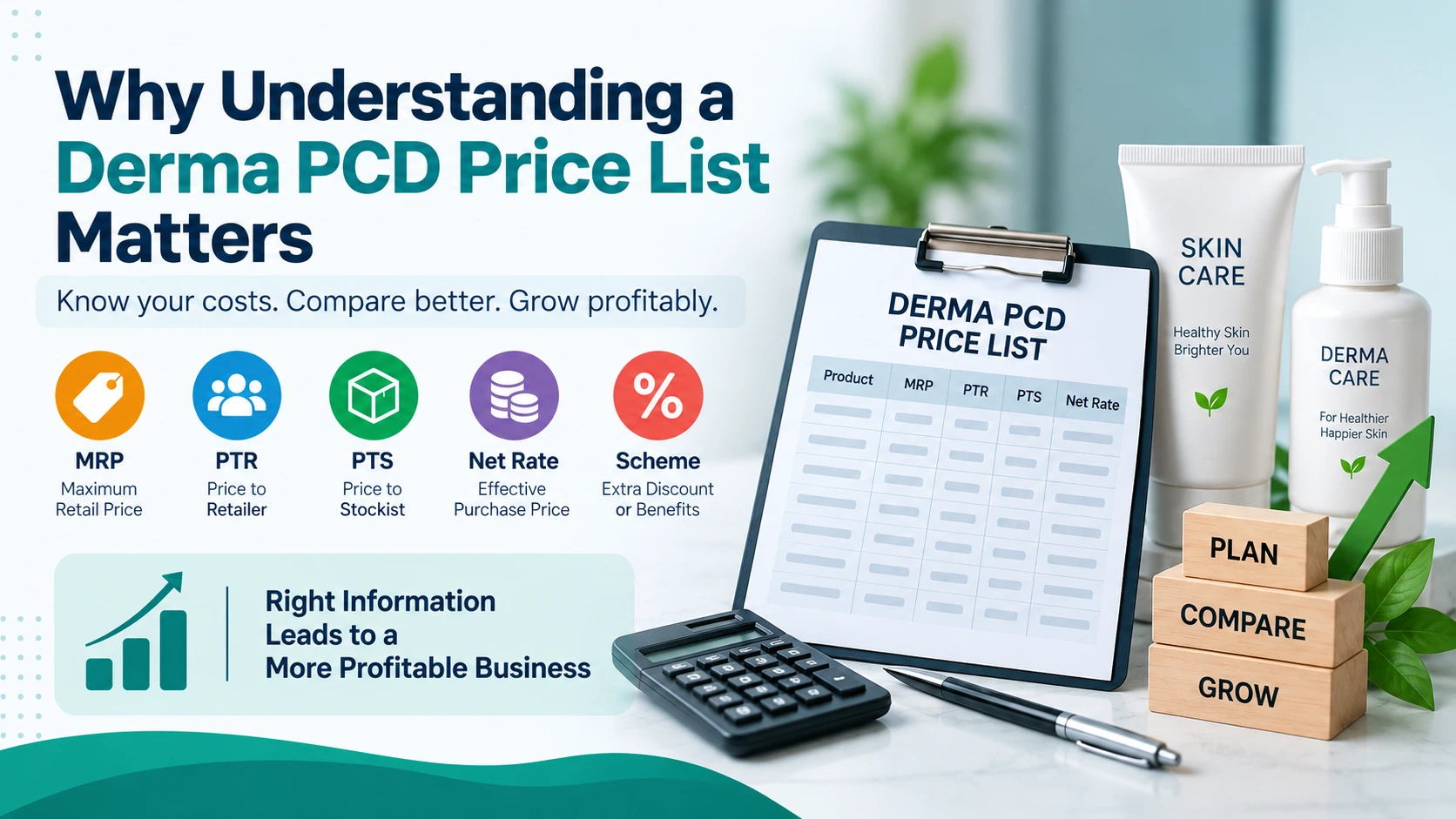
This is especially useful when comparing derma PCD franchise companies. A higher MRP does not always mean higher profit. Your actual return usually depends on the net rate, retailer price, discounts, product demand, and business expenses.
A price list helps you compare:
- MRP: Maximum retail price
- PTR: Price to retailer
- PTS: Price to stockist
- Net Rate: Effective purchase price after applicable discounts
- Scheme: Extra discount or promotional benefits
So, before choosing a dermatology PCD franchise, carefully compare these factors along with MOQ, product demand, expiry policy, and promotional support. This will help you to make a more informed and profitable business decision.
Why the Demra Segment Is Attractive in India
The Indian dermatology market is growing steadily, which makes it an interesting opportunity for entrepreneurs and distributors. According to KPMG’s 2026 report, the market was worth ₹16,000+ crore in 2025, growing at around 8% CAGR from 2021 to 2025. Major categories, such as antifungal, anti-inflammatory, moisturizing, anti-acne, anti-scarring, and topical antibiotic products make up more than 65% of the market.
The demand is also moving towards preventive skincare and OTC products. For entrepreneurs who are planning a Derma PCD franchise in India, this creates an opportunity across derma skincare products.
Understanding PTR, PTS, Net Rates & MRP in a Derma PCD Price List
A Derma PCD price list includes several important pricing terms that help you to understand product costs, margins, and potential profits before starting a franchise. Let’s understand all of these in detail.
What is PTR?
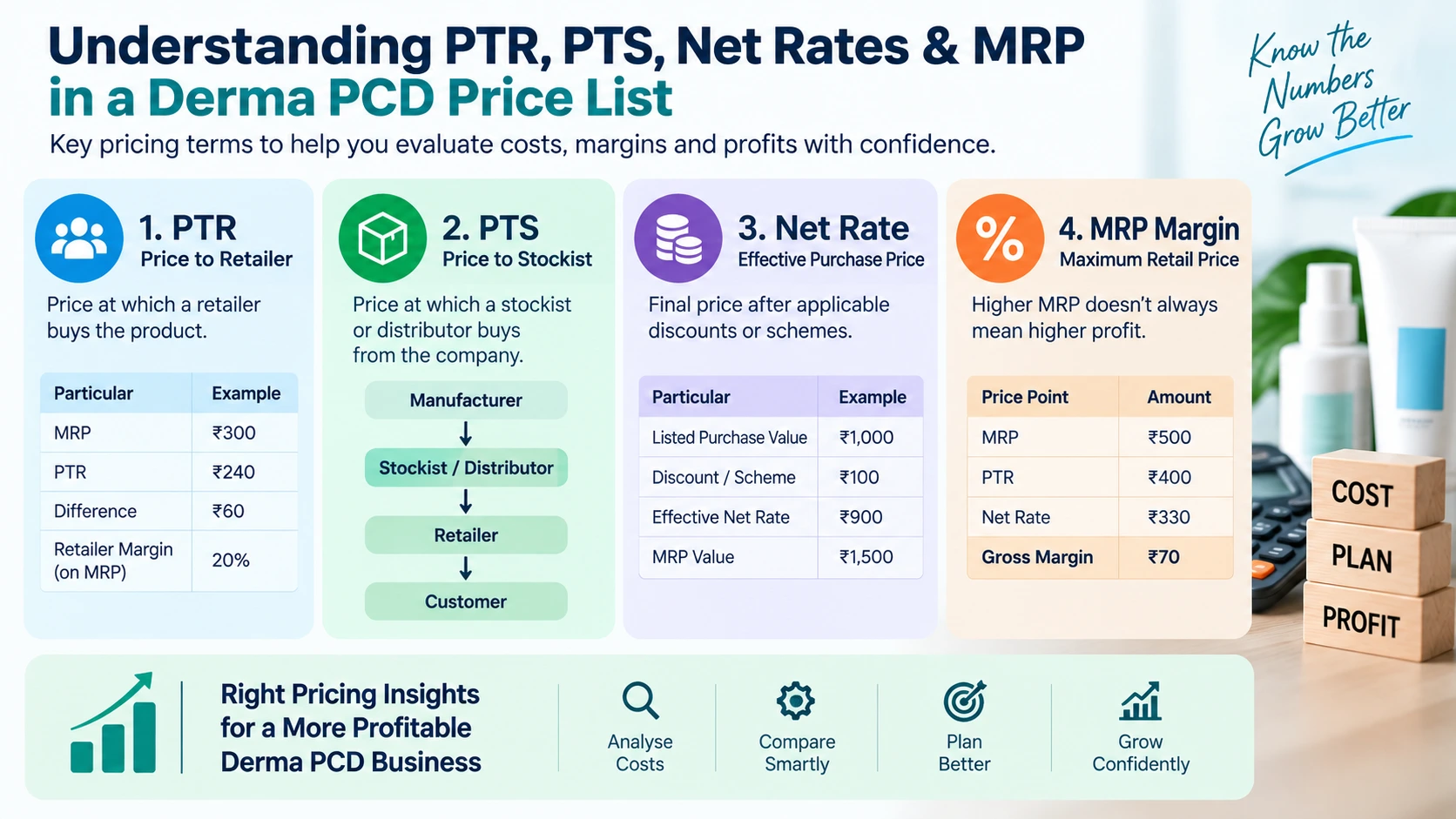
PTR means Price to Retailer. It is the price at which a retailer or chemist buys a product from a distributor or stockist. It helps you to understand the purchase price of retailers and calculate the trade margin in a Derma PCD franchise.
PTR Margin Formula: Retailer Margin % = (MRP − PTR) ÷ MRP × 100
For example:
| Particular | Example |
| MRP | ₹300 |
| PTR | ₹240 |
| Difference | ₹60 |
| Retailer Margin on MRP | 20% |
What is PTS?
PTS means Price to Stockist. It is the price at which a stockist or distributor buys a medicine from the company. In a simple supply chain, the product moves from manufacturer to stockist to retailer and to customer.
For a Derma PCD product price list, PTS helps you to understand the stockist-level purchase price. However, pricing structures can vary between companies. So, always confirm what the PTS, PTR, and Net Rate columns mean before calculating your expected margins.
What is a net rate in a PCD price list?
Net rate is the final price you pay for a product after applicable discounts or schemes. It helps you to understand your actual purchase cost.
For example:
| Particular | Example |
| Listed Purchase Value | ₹1,000 |
| Discount/Scheme | ₹100 |
| Effective Net Rate | ₹900 |
| MRP Value | ₹1,500 |
From this example, the ₹600 difference between the MRP and Net Rate is not your actual profit. Expenses, like retailer discounts, freight, taxes, promotional costs, and expiry losses, can reduce your final earnings.
That’s why you should always check the net rate carefully when comparing a Derma PCD franchise cost and product list.
MRP Margin
MRP stands for Maximum Retail Price, but the difference between MRP and your purchase cost is not necessarily your final business profit.
Your practical calculation should look more like
MRP → Retailer Selling Price → Your Selling Price → Net Purchase Cost → Operating Expenses → Actual Contribution
For example:
| Price Point | Amount |
| MRP | ₹500 |
| PTR | ₹400 |
| Net Rate | ₹330 |
| Gross Margin | ₹70 |
Here, your gross margin is ₹400 − ₹330 = ₹70, or 17.5% of the selling price.
Key Differences: PTR vs PTS vs Net Rate vs MRP
| Term | Simple Meaning | Why It Matters |
| MRP | Maximum price printed on the product | Shows the highest retail price |
| PTR | Price at which the retailer buys the product | Helps understand retailer margin |
| PTS | Price at which the stockist buys the product | Helps understand distributor pricing |
| Net Rate | Final price after applicable discounts or schemes | Helps calculate your actual purchase cost |
| Scheme | Extra discount, offer, or additional product quantity | Can reduce your effective purchase cost |
How to Read a Derma PCD Franchise Price List Step-Wise
Before investing in a derma PCD franchise business, carefully check the product details, pricing, schemes, and terms. These steps can help you to understand the actual cost of potential margin. Let’s see how you can read the price list of a derma PCD franchise step-by-step.
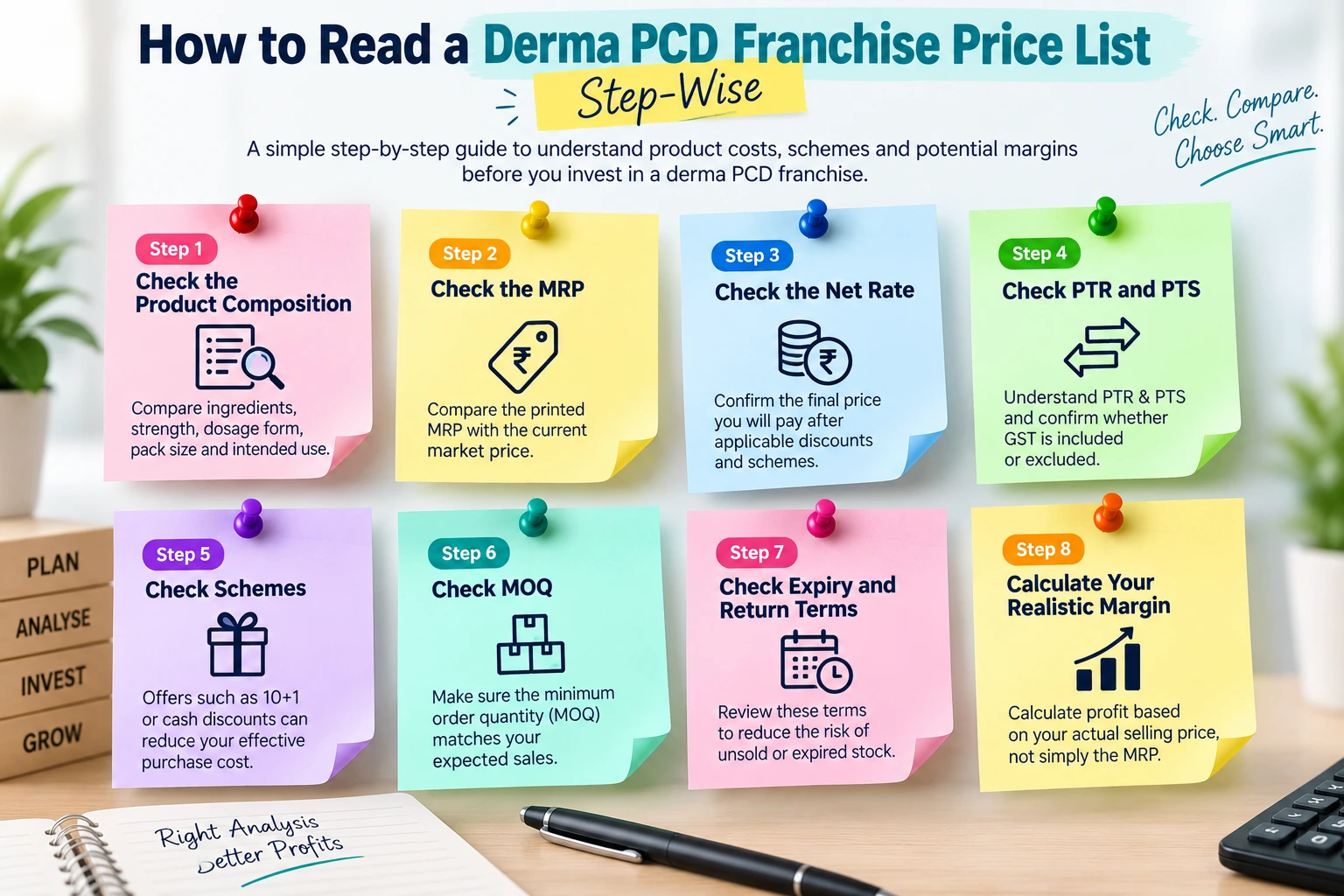
Step 1: Check the Product Composition
Compare the ingredients, strength, dosage form, pack size, and intended use rather than just the brand name.
Step 2: Check the MRP.
Compare the printed MRP with the current market price.
Step 3: Check the Net Rate
Confirm the final price you will pay after applicable discounts and schemes.
Step 4: Check PTR and PTS
Understand the PTR & PTS and confirm whether GST is included or excluded.
Step 5: Check Schemes
Offers such as 10+1 or cash discounts can reduce your effective purchase cost.
Step 6: Check MOQ
Make sure that the minimum order quantity (MOQ) matches your expected sales.
Step 7: Check Expiry and Return Terms
Review these terms to reduce the risk of unsold or expired stock.
Step 8: Calculate Your Realistic Margin
Calculate profit based on your actual selling price, not simply the MRP.
How to Calculate Your Actual Derma PCD Profit
Calculating your Derma PCD profit helps you to understand how much you can actually earn from each product. A simple calculation is
Gross Profit = Actual Selling Price − Effective Purchase Cost
For example:
- Selling price to retailer = ₹400
- Net purchase rate = ₹330
- Gross Profit = ₹70
Your final profit may be lower after expenses, such as transportation, sales visits, promotional costs, staff salaries, storage, credit costs, expired stock, and taxes.
That’s why always remember that gross trade margin is not the same as net business profit. Always consider your complete operating costs when evaluating a Derma PCD franchise.
Conclusion
A derma PCD franchise price list should not be judged only by MRP. Before choosing a franchise, compare the PTR, PTS, net rate, MRP, territory rights, and product demand to understand the actual business potential. In the above blog, we have mentioned a complete breakdown of the derma PCD franchise price list. So if you are planning to start a dermatology PCD franchise, learning how to read and compare a derma PCD price list is therefore very important. This guide will help you choose products wisely, understand your potential margins, and make better business decisions.
Moreover, for entrepreneurs who are evaluating a Derma PCD franchise cost, Bioglint Derma Care provides a dermatology-focused product portfolio, a territory-based monopoly franchise model, and PTS/PTR commercial information for prospective partners.
So, before investing, request the latest Derma PCD product price list from Bioglint, verify the net rates and commercial terms, and calculate your expected margin product by product.
Frequently Asked Questions
What is the difference between PTR and PTS?
PTR generally represents the retailer-level price, while PTS generally represents the stockist-level price. The exact commercial structure can vary between companies.
How much margin can I earn from a Derma PCD franchise?
There is no universal margin. Bioglint’s current guidance discusses margins that can range from 20% to 50% depending on product category, but actual returns depend on the product, net rate, selling price, volume, and operating costs.
Does Bioglint Derma Care offer monopoly rights?
Yes. Bioglint’s current franchise information describes territory-based monopoly rights supported by a formal franchise agreement.
Does MRP determine the profit in a Derma PCD franchise?
No. MRP is not the same as profit. Your actual return depends on the effective purchase price, realistic selling price, retailer margin, schemes, taxes, logistics, sales expenses, and other business costs.
How often should I update my Derma PCD price list?
You should use the latest price list supplied by the company because product prices, MRPs, schemes, taxes and commercial terms can change. Avoid relying on an old PDF or price list when calculating your current margins.
