
How to Start a Derma PCD Pharma Franchise As A Pharma Distributor – Step-by-Step Guide (2026)

Starting a Derma PCD pharma franchise is one of the most rewarding business decisions a pharma distributor can make in 2026. The Indian dermatology pharmaceutical market has crossed Rs. 20,000 crore and is growing steadily at a CAGR of over 12%, driven by increasing skin disorders, urban pollution, growing cosmetic awareness, and a rising middle class that actively spends on skincare. What makes this even more significant is that over 40% of outpatient visits to dermatologists in India involve prescriptions for skin infections, acne, or pigmentation conditions that require consistent, long-term medication.
Yet, despite the obvious opportunity, many pharma distributors who want to start their own Derma PCD franchise don’t know where to begin. Choosing a company, understanding the franchise model, fulfilling legal requirements, building a product portfolio, and generating sales, the process can seem overwhelming without a clear roadmap.
This step-by-step guide is built specifically for pharma distributors in 2026 who are ready to launch their own Derma PCD pharma franchise from the ground up, not just add products to an existing business, but own a dedicated derma franchise territory and build it as an independent revenue stream.
Understanding What a Derma PCD Franchise Actually Means
Before you start, you need to be crystal clear on what the Derma PCD model is and what it is not.
PCD stands for Propaganda Cum Distribution. In this model, a pharma company grants you the rights to market and distribute its dermatology products in a defined geographic territory under its brand name. You are not manufacturing anything. You are not required to invest in infrastructure or R&D. What you own is the exclusive right to sell the company’s derma products in your territory, backed by their brand, certifications, and product portfolio.
As a franchise holder, you typically purchase products at a net rate (distributor price), sell them to chemists and doctors at PTR (Price to Retailer) or PTS (Price to Stockist), and earn the difference as your margin. In the derma segment, these margins are significantly higher than general pharma, often ranging from 20% to 50%, depending on the product category.
The key differentiator of the PCD model is monopoly rights. A credible derma PCD company gives you exclusive territorial rights, ensuring no other distributor from the same company competes with you in your area. This is the foundation of your competitive advantage.
Step 1. Define Your Business Goal and Territory
Every successful Derma PCD franchise starts with clarity. Before you approach any company, define:
Your territory – Which city, district, or region do you plan to operate in? Be specific. The monopoly rights you negotiate are directly tied to the territory you claim. Larger territory means more potential – but also more resources required to cover it effectively. As a starting distributor, focus on a geography you know well and already have a network in.
Your target customers – Derma franchise sales happen through three primary channels: dermatologists and skin specialists, general physicians who prescribe basic derma products, and retail chemists and beauty pharmacies. Identify which channel is most accessible to you based on your existing relationships.
Your revenue target – Set a realistic monthly and annual sales goal. This will determine how many SKUs (Stock Keeping Units) you need, what marketing budget to allocate, and how aggressively to build your doctor and chemist network. Having this clarity upfront makes every subsequent step faster and more focused.
Step 2. Ensure You Have the Required Legal Documents
To operate a Derma PCD franchise legally in India, you need to have the following documents in place before signing any agreement:
Drug Licence Number (DL) – This is mandatory for distributing pharmaceutical products. If you are already a pharma distributor, you likely have this. For cosmeceutical or OTC-only derma products, requirements may vary by state, but a drug licence is strongly recommended for credibility and compliance.
GST Registration – All pharma and derma product transactions above the threshold require a valid GSTIN. Ensure your GST registration is active and updated.
Firm Registration / Business Entity Proof – Whether you operate as a sole proprietor, partnership, or private limited company, you need proof of your business entity, typically a Udyam Registration or a Partnership Deed.
Bank Account in Business Name – Payments to the derma franchise company will be processed under your business name, so a business bank account is essential.
If you are starting fresh and don’t yet have a drug licence, the application process involves obtaining it from your State Drug Control Authority, which requires a qualified pharmacist on staff at your distribution premises. The timeline is typically four to six weeks.
Step 3: Research and Shortlist the Right Derma PCD Company
This is the most consequential step in the entire process. The company you partner with will determine your product quality, market reputation, supply consistency, and profit margins. Spend adequate time here – a poor partnership is far more costly than a delayed start.
When evaluating a Derma PCD franchise company, assess the following criteria rigorously:
Manufacturing Credentials – Only work with companies whose products are manufactured in WHO-GMP certified facilities. This is non-negotiable; it protects you from regulatory risk, product quality complaints, and liability.
Product Portfolio Depth – A strong derma franchise company should offer a complete dermatology range — tablets, capsules, creams, lotions, gels, ointments, soaps, face washes, shampoos, dusting powders, and serums. The broader the range, the more prescriptions and chemist requirements you can fulfil from a single source.
Monopoly Rights Policy – Confirm in writing that the company offers exclusive monopoly-based distribution rights for your territory. Get this clearly outlined in the franchise agreement – vague language around exclusivity is a red flag.
Pricing and Margin Structure – Request the company’s full price list and calculate your effective margin after accounting for GST and logistics. Evaluate PTR, PTS, and net rates carefully. A healthy derma franchise should offer you margins that allow competitive pricing to chemists while ensuring your profitability.
Promotional Support – The best derma PCD companies provide you with visual aids, MR bags, product cards, catch covers, reminder cards, sample strips, and digital marketing material. This support directly reduces your cost of market entry and doctor detailing.
Supply Reliability and Lead Time – Ask about production lead times and minimum order quantities. A company that takes four to six weeks to fulfil orders will hurt your market credibility. Look for partners with a ready-to-dispatch inventory system.
Companies like Bioglint Derma Care, with a comprehensive derma portfolio, WHO-GMP certified manufacturing, monopoly franchise rights, and strong promotional backing, represent the kind of partnership that sets a new franchise holder up for sustainable success.
Step 4: Finalise the Franchise Agreement
Once you have shortlisted your company, review the franchise agreement carefully before signing. Key clauses to examine:
Territory definition – The agreement must clearly name the specific geographic area where you hold exclusive rights – by district, PIN code range, or city.
Minimum order commitments – Understand the minimum purchase obligation per month or quarter. Ensure it is realistic relative to your territory’s demand potential.
Payment terms – Know whether the company works on advance payment, credit, or a hybrid model. Most reputable derma PCD companies operate on advance payment, especially for new franchise holders.
Termination conditions – Understand the exit terms, how much notice is required, what happens to unsold inventory, and what conditions can lead to termination of exclusivity.
If you are unsure about any clause, consult a basic legal advisor before signing. A clear agreement protects both parties and prevents disputes later.
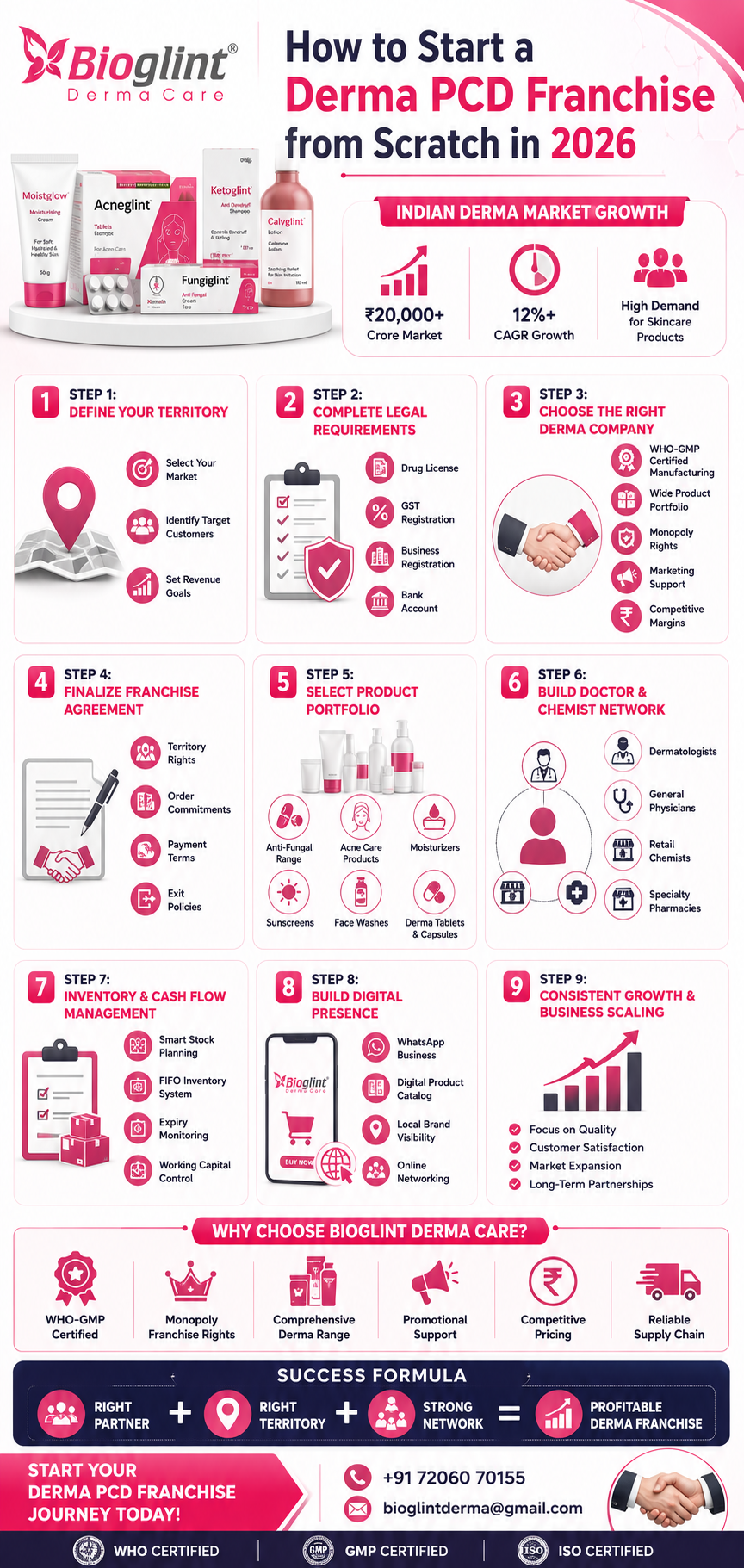
Step 5: Select Your Initial Product Basket Strategically
You don’t need to launch with the entire product catalogue. A smart, focused initial product basket reduces your working capital requirement, simplifies training, and helps you build early market traction.
Start with high-rotation derma products that address the most common conditions in your territory – anti-fungal creams, moisturising lotions, acne gels, medicated face washes, sunscreen formulations, dandruff shampoos, and basic derma tablets and capsules.
Aim for a basket of 25 to 40 SKUs across categories to start. This gives doctors and chemists a meaningful range to work with while keeping your inventory manageable. Expand the basket progressively as sales data shows which categories are performing.
Step 6: Build Your Doctor and Chemist Network
This is where your franchise becomes a real business. Your growth in the derma PCD space is directly proportional to the quality and size of your professional network.
For dermatologists and skin specialists – Schedule one-on-one product detailing meetings. Carry product visual aids and samples. Focus on differentiating your brand – highlight the GMP certification, product formulation quality, and consistent availability. Don’t expect immediate prescriptions; relationship-building in medical sales typically takes two to four visits before a doctor begins prescribing.
For general physicians – Many GPs prescribe basic derma products like antifungals, mild corticosteroids, and moisturisers. These are easier to access than dermatologists and represent a high-volume channel.
For chemists and speciality pharmacies – Cover skin-care and beauty pharmacies in your territory that already stock derma products. Introduce your brand, offer initial schemes or promotions if your company supports it, and establish regular supply cycles.
Track your visits, follow-ups, and order conversions systematically, even a simple spreadsheet works at the start. This data will help you allocate your time and resources to the highest-potential customers.
Step 7: Manage Inventory and Cash Flow Efficiently
Inventory management is often the biggest operational challenge for new Derma PCD franchise holders. Since most companies work on advance payment, you are purchasing before sales materialise, making cash flow discipline essential.
Order based on actual demand signals, not just enthusiasm. In the first three months, place conservative orders and restock frequently rather than buying large quantities upfront. This keeps your working capital liquid and reduces the risk of expiry-related losses.
Maintain a first-in, first-out (FIFO) inventory system to ensure older stock moves before newer batches. Monitor expiry dates monthly, especially for creams and lotions that have shelf lives of 18 to 24 months. Keep a close eye on your top-moving SKUs so you never face stockout situations with your key doctors.
Step 8: Leverage Digital Presence for Market Credibility
In 2026, even a pharma franchise business benefits from a basic digital presence. A professional WhatsApp Business profile with your product catalogue, a simple visiting card with your franchise name and territory, and an active presence in local pharma and doctor WhatsApp groups can meaningfully increase your visibility.
Some derma franchise holders have also found success in promoting their range through short educational content for chemists on product benefits – shared via WhatsApp or Instagram. This doesn’t replace field sales but reinforces your brand and builds recall between doctor visits.
Final Words
Starting a Derma PCD pharma franchise in 2026 is a structured, low-risk, high-potential business for pharma distributors who are ready to build a focused dermatology vertical. The market demand is strong, the franchise model is proven, and the margins are compelling. What determines success is the quality of your partner company, the focus of your territory strategy, and the consistency of your doctor and chemist engagement.
Bioglint Derma Care offers everything a new Derma PCD franchise holder needs – a comprehensive WHO-GMP certified derma product range, exclusive monopoly rights, competitive pricing, and robust promotional support – making it an ideal launchpad for building a profitable derma franchise business from scratch.
Frequently Asked Questions (FAQs)
How much investment is needed to start a Derma PCD franchise in 2026?
A Derma PCD franchise can be started with an initial investment of Rs. 20,000 to Rs. 1,00,000 depending on the product basket size and territory, making it one of the most accessible pharma business models available.
Is a drug licence mandatory to start a Derma PCD franchise?
Yes, a valid drug licence is required for distributing prescription derma products; however, for purely OTC and cosmeceutical products, requirements may vary by state. Always verify with local drug authorities.
Can a first-time business owner start a Derma PCD franchise, or is pharma experience required?
While prior pharma distribution experience is an advantage, it is not mandatory – many successful Derma PCD franchise holders started fresh, supported by the training and marketing material provided by their franchise company.
What is the difference between a Derma PCD franchise and a general pharma PCD franchise?
A Derma PCD franchise is specialised exclusively in dermatology and skin care products, offering higher margins and a more focused market – unlike general pharma PCD, which spans multiple therapeutic segments.
How long does it take to generate consistent revenue from a Derma PCD franchise?
Most Derma PCD franchise holders begin seeing consistent monthly revenue within three to six months, once their doctor and chemist network is established and initial prescription habits are built.
